How I Handle Emergency Cake Orders as a Baker
My Real-Life Baking Experience
If you are a baker, you will probably agree with me that not every cake order comes in with enough notice. Sometimes, a customer contacts you when you least expect it and asks if you can deliver a cake that same day.
Your plans may already be in place, your ingredients may not be ready, and you may not even have imagined that you would be baking that day. But then comes the big question: “Please, can you make this cake for me today?”
And just like that, your kitchen becomes a busy workplace!
Welcome to Bake with Ruby, where I share my baking experiences, practical tips, and lessons I have learned along the way.
Today, I want to talk about something many bakers can relate to: how I handle emergency cake orders as a baker.
Emergency orders can be stressful, exciting, and sometimes funny when you look back at the experience. They have taught me the importance of preparation, patience, time management, and finding practical solutions when things do not go exactly as planned.
Let me share how I approach these unexpected orders and what other bakers can learn from the experience.
What Is an Emergency Cake Order?
An emergency cake order is a request from a customer who needs a cake within a very short period, sometimes on the same day.
It could be for a birthday celebration, a surprise for a loved one, a small family gathering, or an event that is happening sooner than expected.
While some customers place their orders days or weeks in advance, others remember at the last minute or suddenly find themselves in need of a cake.
As bakers, we understand that customers have different situations. Sometimes, we can accommodate them, and sometimes, we simply cannot.
The important thing is knowing how to assess the request without compromising the quality of your work.
1. I First Check if the Order Is Possible
Whenever an emergency cake order comes in, the first thing to consider is if I can realistically complete it within the available time.
I consider the type of cake the customer wants, its size, the design, the ingredients required, and the delivery deadline.
A simple buttercream cake may be possible within a few hours, depending on the recipe and workload. However, a large, multi-tiered cake with complicated decorations may require much more time.
I also consider any orders I have already accepted.
My lesson: Never agree to an emergency order simply because you do not want to disappoint a customer. It is better to be honest about what you can deliver than to accept a job you cannot complete properly.
2. I Confirm the Details Before Starting
Before I begin, I make sure I understand what the customer wants. This includes the cake flavour, size, design, inscription, budget, collection or delivery arrangement, and the exact time the cake is needed.
I also explain any limitations. For example, if there is not enough time for a complicated design, I may suggest a simpler alternative that can still look beautiful.
This helps the customer understand what is possible and gives me a clear plan to follow.
For emergency orders, clear communication is just as important as baking skills.
3. I Organise My Ingredients and Equipment Quickly
Once I accept the order, it is time to get to work.
I check my ingredients and gather everything I need before mixing the batter. I also prepare my cake pan, measuring tools, mixing bowl, and other equipment.
This step may seem small, but it saves valuable time.
Imagine starting a cake and discovering halfway through that you do not have baking powder or that the flavour the client wants is not available. That alone can delay or ruin the entire process.
Preparing my workspace helps me focus on the job instead of searching for things while the clock is ticking.
A helpful tip for bakers: Keep frequently used ingredients and tools organised. A well-arranged baking space makes it easier to respond when an urgent order comes in.
4. I Choose a Cake Design That Fits the Time Available
One thing I have learned is that an emergency order is not always the best time to experiment with a complicated design.
When a customer needs a cake urgently, I consider a design that I can execute neatly within the available time.
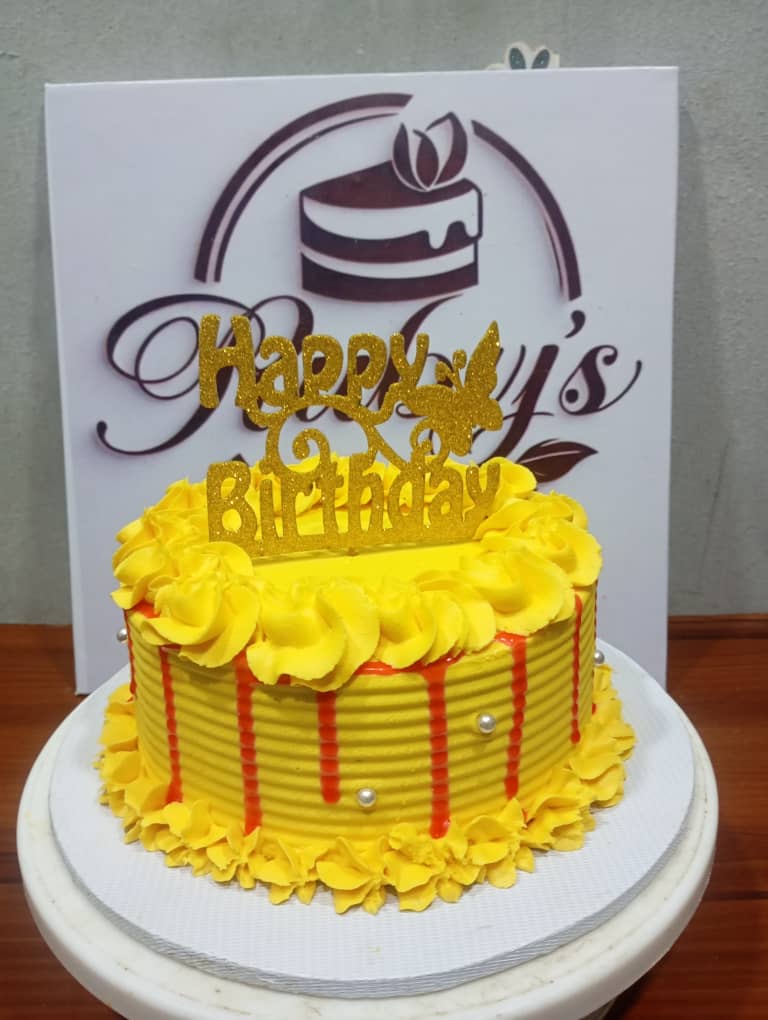
A simple design with smooth buttercream, clean borders, and a beautiful color combination can look just as attractive as a more elaborate cake.
The goal is to deliver a cake that meets the customer’s expectations while maintaining good quality.
I would rather produce a simple, well-finished cake than rush through a complicated design and deliver something I am not proud of. After all, the appearance of your cake is part of your brand.
5. The Cake-Cooling Stage Can Be a Real Test of Patience!
Now, this is the part many bakers will understand!
One of the biggest challenges with a same-day cake order is waiting for the cake to cool before decorating it.
You have mixed the batter, baked the cake, and finally brought it out of the oven. You are already thinking about the beautiful decorations you want to add, but the cake is still hot.
You cannot simply cover a hot cake with buttercream and expect everything to go well. The heat can melt the frosting and make the decoration difficult to manage.
I have had emergency orders where I needed to cool a cake quickly before icing it. And sometimes, when you are racing against time, you find yourself fanning the cake to help it cool.
Yes, friend, you read that correctly!
There have been times when I used a standing fan, and when there was no electricity, I resorted to using a hand fan.
That is one of those real-life baking moments that can make you laugh later, even when you were under pressure at the time.
But here is an important lesson: never let the urgency of an order make you decorate a cake before it has cooled sufficiently.
How I manage cake cooling during emergency orders
- I remove the cake from the oven as soon as it is properly baked.
- I transfer it to a cooling rack.
- I allow air to circulate around the cake so heat can escape.
- I prepare my buttercream and decorating tools while the cake cools.
- I make sure the cake is sufficiently cool before applying the frosting.
If I use a fan, I keep it clean and positioned so that it does not blow dust or other contaminants onto the cake.
I also avoid placing a hot cake in a refrigerator or freezer without considering the risks of condensation and damage to the cake’s texture.
Good time management begins before the cake comes out of the oven. Using the cooling period to prepare the next stage of the work can save valuable time.
6. I Stay Focused Instead of Panicking
When the deadline is close, it is easy to become overwhelmed.
You may start thinking about how much work remains, whether the cake will be ready on time, and what will happen if something goes wrong.
I have learned that panicking does not make the cake bake faster!
Instead, I focus on the next task that needs to be completed.
If the cake is baking, I can prepare the buttercream or organize the decorating tools. If the cake is cooling, I can prepare the cake board and box. If the decorations are ready, I can plan the finishing touches.
Breaking the work into smaller tasks helps me stay organized.
7. I Do Not Allow Urgency to Compromise Quality
A customer may need a cake urgently, but that does not mean the quality should suffer.
I still pay attention to the taste, texture, appearance, cleanliness, and safe handling of the cake.
I make sure the cake is fully baked, the frosting is suitable, and the decorations are properly finished.
I also check the cake before packaging it to make sure it looks presentable and matches what was agreed upon.
If I realise that the requested design cannot be completed safely or to an acceptable standard within the available time, I communicate with the customer and discuss realistic alternatives.
A successful emergency order is not simply about delivering quickly. It is about delivering something the customer can enjoy and feel happy about receiving.
8. I Make Sure Packaging and Delivery Are Properly Planned
After decorating the cake, I still need to package it and arrange for collection or delivery.
This stage can easily be forgotten when the focus is entirely on baking and decorating.
I make sure the cake board is secure, the box is appropriate for the cake, and the decorations are protected as much as possible during transportation.
If the cake contains perishable fillings or frostings, I consider the appropriate temperature and handling requirements.
I also communicate with the customer about the collection or delivery time rather than leaving them guessing.
Remember, your responsibility does not end when you finish decorating the cake. The cake must also reach the customer in good condition.
9. I Learn Something From Every Emergency Order
Every urgent order gives me an opportunity to learn.
Sometimes, I discover a better way to organise my workspace. Other times, I realise that certain ingredients should always be available or that I need to improve how I estimate my production time.
Even the stressful moments can teach useful lessons.
For example, preparing frequently used ingredients in advance, keeping essential decorating tools accessible, and having a few simple cake designs in mind can make future emergency orders easier to handle.
I also pay attention to the parts of the process that take the longest. This helps me understand where I can improve my efficiency without sacrificing quality.
Baking is not only about following recipes. It is also about learning from experience and becoming better with every order.
10. I Remember That I Am Allowed to Say No
This is an important lesson for every baker.
It is tempting to accept every order because you want to satisfy your customers and earn more money. However, not every emergency order will be suitable for your schedule.
You may already have several cakes to prepare, lack the necessary ingredients, or simply not have enough time to complete the request properly.
In such situations, it is okay to decline politely.
You can explain that you are unable to take the order within the requested timeframe and, where possible, offer a date or alternative that works for both of you.
Your health, existing commitments, and the quality of your work matter too.
Being a professional baker does not mean saying yes to everything. It means knowing your limits and managing your business responsibly.
Frequently Asked Questions About Emergency Cake Orders
Can a baker make a cake on the same day?
Yes, depending on the cake size, design, available ingredients, equipment, workload, and deadline. Simple cakes may be possible on the same day, but elaborate designs require more time.
Should I charge extra for emergency cake orders?
You may choose to charge an emergency fee if the order requires additional work, unusual scheduling, or extra expenses. Explain the fee clearly before accepting the order.
How can I cool a cake faster before decorating it?
Allow the cake to cool according to the recipe, then transfer it to a suitable cooling rack when appropriate. Prepare your frosting and decorating tools while you wait. Clean, gentle airflow can help, but never apply frosting while the cake is still too warm.
What should I do if I cannot complete an urgent cake order?
Be honest with the customer as early as possible. If you cannot deliver a cake of acceptable quality within the available time, politely decline or offer a simpler design or a later collection time.
Handling emergency cake orders is one of those experiences that reminds me that baking is not always as calm and organised as it looks from the outside.
Sometimes, everything goes according to plan. Other times, you are working against the clock, checking the cake, preparing the frosting, arranging the packaging, and trying to make sure the customer gets what they ordered.
And sometimes, you may even find yourself fanning a cake because you need it to cool before decorating!
These experiences may be stressful in the moment, but they can also teach us valuable lessons about preparation, patience, time management, and the importance of knowing our limits.
For me, baking is more than mixing ingredients and putting a cake in the oven. It is a journey of learning, problem-solving, creativity, and growth.
When an emergency order comes in, take a moment to plan your next steps. A calm mind makes it easier to make good decisions.
At Bake with Ruby, I want to share not only recipes but also the real experiences behind being a baker, because I believe that these lessons can help someone else on their baking journey.
I hope you can now handle emergency cake orders as a baker.
Now, I would love to hear from you!
Have you ever received an emergency cake order that left you rushing against time? What happened, and how did you handle it? Share your experience in the comments. Let’s learn from one another!
Happy baking, and see you in the next post!
— Bake with Ruby ❤️🧁