Four years ago when I decided to go into baking fully, I had no Oven.
All I had was an ancient pot that was given to me by my mom to use.
I used that pot to make so many cakes, then I started saving towards getting an oven and I got it.
Today the story is different because I didn’t give up.
Have you ever wanted to bake a cake but stopped because you don’t have an oven?
Maybe you’re just starting your baking journey, you’re working with a small budget, or you simply don’t have access to an oven yet. Whatever the reason, not having an oven doesn’t mean you have to give up on baking.
There are simple ways to bake delicious cakes using equipment you may already have in your kitchen.
In this post, I’ll show you how to bake without an oven and share some helpful tips to make sure your cake comes out soft, moist, and properly cooked.
Can You Really Bake Without an Oven?
Yes, you can!
Although an oven is the traditional equipment used for baking, cakes can also be baked using alternative heat sources. The most popular method is stovetop baking, where a large pot or cooking pot is used to create an oven-like environment.
This method is particularly useful for beginner bakers who are still building their baking equipment.
Method 1: Baking Cake Inside a Pot
One of the easiest ways to bake without an oven is by using a large, heavy-bottomed pot.
What You Need
- A large deep pot with a tight-fitting lid
- A baking pan
- A wire rack, trivet, or heat-resistant stand
- Your cake batter
- A stovetop or gas cooker
How to Do It
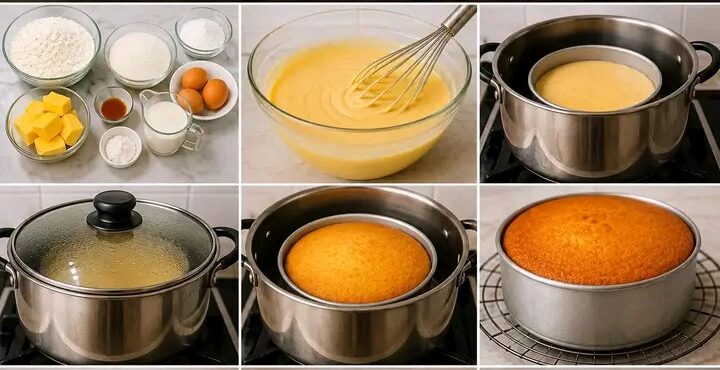
1. Prepare your cake batter.
Make your cake batter according to your preferred recipe and pour it into a greased and lined baking pan.
2. Prepare the pot.
Place a wire rack or trivet inside the pot. The baking pan should sit on the rack rather than directly on the bottom of the pot.
This helps prevent the bottom of the cake from getting burnt.
3. Preheat the pot.
Cover the empty pot with its lid and preheat it over low-to-medium heat for about 10 minutes.
4. Place the cake inside.
Carefully put your filled baking pan on the rack inside the preheated pot.
Cover the pot immediately.
5. Bake over low heat.
Allow the cake to bake over low heat. Avoid constantly opening the lid because this allows heat to escape and can affect how your cake rises.
6. Check for doneness.
After the cake has baked for some time, insert a skewer or toothpick into the center, If it comes out clean or with a few moist crumbs, your cake is ready.
Remove it carefully and allow it to cool before decorating.
Method 2: Using Sand in a Pot
Another traditional method used by some home bakers is sand baking.
Clean, dry sand is placed inside a large pot to create an even layer between the heat source and the baking pan.
The cake pan is then placed on top of the sand and the pot is covered.
The sand helps distribute heat and prevents the baking pan from sitting directly over the flame.
However, if you’re a beginner, I recommend using a wire rack or trivet when possible because it is easier to control and keep clean.
Method 3: Using Salt in a Pot
Use same procedure as method 2
Important Tips for Baking Without an Oven
Baking without an oven requires a little patience. Here are some tips that can make a big difference:
1. Always Use Low Heat
High heat can burn the bottom of your cake while leaving the center/middle uncooked.
Low, steady heat is the key.
2. Preheat Your Pot
Just like you preheat an oven, you should preheat your pot before putting your cake inside.
This creates a more stable baking environment.
3. Don’t Put the Baking Pan Directly on the Pot
Always create some distance between the cake pan and the bottom of the pot using a rack, trivet, or another suitable heat-resistant stand.
4. Keep the Lid Closed
Every time you open the lid, heat escapes.
Try to resist checking your cake too frequently.
5. Use the Right-Sized Pot
Your pot should be large enough to comfortably accommodate the baking pan while still allowing enough space for hot air to circulate around it.
6. Watch Your Heat
If you’re using a gas cooker, the flame should not be touching the sides of the pot excessively.
Too much heat can cause uneven baking and burnt cake.
How Long Does It Take to Bake a Cake Without an Oven?
The baking time depends on several factors, including:
- The type of cake
- The size of the baking pan
- The thickness of the batter
- The type of pot you’re using
- The heat level
Instead of relying only on time, always check the cake using a skewer or toothpick.
If it comes out clean, your cake is likely ready.
Can You Bake Other Things Without an Oven?
Absolutely!
With the right setup, you can use stovetop methods for different baked foods, including:
- Vanilla cake
- Chocolate cake
- Banana bread
- Bread
- Small cakes
- Some pastries
However, different recipes may require different cooking temperatures and techniques, so you may need to adjust your method.
Common Mistakes to Avoid
If you’re new to stovetop baking, avoid these common mistakes:
Using high heat: This can burn your cake before the center/middle is cooked.
Skipping preheating: Your cake may not bake evenly.
Opening the lid repeatedly: This causes heat loss.
Using a very thin pot: Thin pots can create hot spots and increase the chances of burning the cake.
Putting the pan directly on the heat: Always use a rack or stand to create some separation.
Final Thoughts
Not having an oven shouldn’t stop you from learning how to bake.
With a good pot, a suitable baking pan, controlled heat, and a little patience, you can make delicious cakes right on your stovetop.
So if you’ve been saying, “I want to learn baking, but I don’t have an oven,” take this as your sign to start with what you have.
Remember, every professional baker started somewhere. You don’t need to have every piece of equipment before you begin.
Start with what you have, learn the basics, keep practicing, and improve as you go.
Happy baking!
About Ruby
I’m Ruby, a passionate baker and the creative mind behind Ruby’s Creamy Delight. I love sharing practical baking tips, recipes, and lessons from my baking journey to help beginners become more confident in the kitchen.